Ahhh yes, training. A term all of us dancers typically use when we want to be the very best (cue Pokemon theme song). Whether our goal is to travel across the globe to spread our art, make it into a dance team, or to simply feel confident, no goal is achieved without the laborious process of “training”.
Training within the dance community has been typically referred to as taking a dance class, freestyling, or more recently, “training like athletes”. But what does “training like athletes” actually mean? Does that mean should I be able to squat 700 lbs? Do I need to sprint a 40 yard dash in 5 seconds??
WHY IS THIS IMPORTANT???
In a time where sharing content through social media is flourishing more than ever, competitive and choreography-based dance has reached new heights, both in its creative and physical capabilities, with its training aspects developing and creeping in just beyond the horizon. Slowly, but surely, dancers are truly being trained like athletes through the incorporation of weight-lifting and athletic-like movements in their training regiment.
Unfortunately, the start of something new comes with a lot of uncertainty, misinformation, and a lack of education. A properly curated training program for dancers will allow them to not only feel stronger when dancing, but also be able to actively move through your full range of motion, preventing injuries.
You’re probably thinking, “Jules, I get it. We need to train the right way, but what does that actually look like?”
Here are 3 Tips to Take It to the Next Level
***ALL TRAINING PROGRAMS SHOULD BE INDIVIDUALIZED. FURTHER INFORMATION IS GENERALIZED FOR THE OVERALL POPULATION***
1. Strength Training
Let’s start with the basics. Strength training works the muscles of your body by taking your joints through different ranges of motion, often with resistance (weights, resistance bands, body weight, etc.).
As a dancer, you constantly toss around your body. Down to the floor and back up, side to side, and sometimes… upside down? Imagine you land on one leg, but your leg muscles (such as your quads, glutes, and hamstrings) are inactive (aka your body doesn’t know how to use them). All of a sudden you’re putting all of your body weight and more into your knee and BOOM. Say bye-bye knee ligaments.
If your body is moving in these ways, we need to train the muscles that control those directions. Incorporating basic exercises into your program more regularly will strengthen the muscles you use when dancing and prevent injury. Examples include, but are not limited to:
- Squats
- Deadlifts
- Push-Ups
- Planks
- Russian Twists
Start off by trying 3 sets of 8 for each of these exercises, focusing on slowing down on the downwards part of the movement, and exploding on the upwards part of the movement.
2. Mobility Training
Before we cover briefly how to train mobility, maybe we should start by explaining what it is.
Mobility is the ability to move a limb through its full range of motion. And no, this is not the same as flexibility, which is the length of your muscle. Static and dynamic stretching allow temporary access of your range of motion, mobility allows you to access that range off the bat with a lot more control.
Mobility is controlled, voluntary movement through its entire range of motion, and a lack of mobility is why so many people, not just limited to dancers, experience injury and pain.
Examples of mobility exercises include, but are not limited to:
- 90/90s
- Combat stretch
- Handcuff with Rotation
- Thread the Needle
The focus of these exercises is to get to your end range of motion and hold tension at those positions while pushing to reach even further. Do about 1 set of 5 with a 5 second hold at your end range for each of these exercises.
3. Plyometric Training
What? Pl-eye-o….metrics?
Yes yes, plyometrics. A fancy word used to describe what you’ve seen your favorite dancer do all over Instagram when they train. To put it in simple terms, plyometrics encompasses movements that involved jumping, landing, and explosive movements.
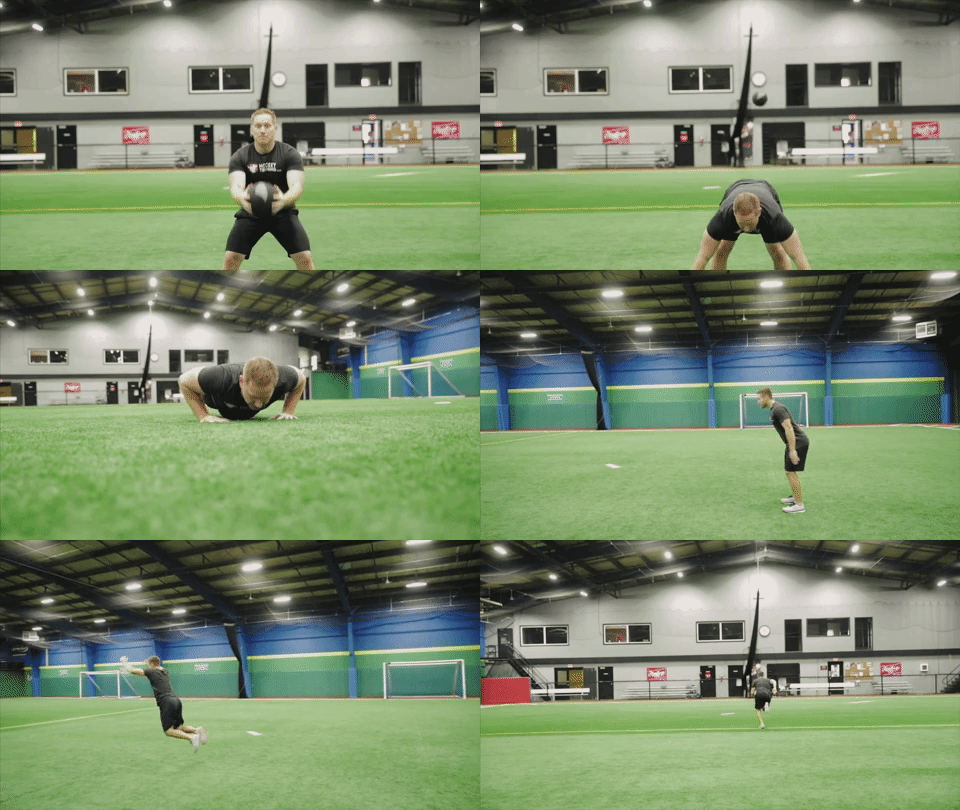
This type of training is misconstrued as a way to condition your body and push it to failure, but that should NOT be the goal when it comes to plyometrics. Yes, you will get tired, but the purpose of these movements is to TEACH your body how to use the muscles you’ve been strengthening when performing certain explosive movements.
Examples of plyometrics include, but are not limited to:
- Box jumps
- Depth drops
- Skater Hops
- Jump Squats
- Tuck Jumps
Limit yourself to 3 sets of 5 for your more explosive exercises to start. Really focus on taking time between each rep to ensure that you are setting yourself up optimally.
Well there ya have it folks! 3 types of training ALL dancers need to incorporate into their training regiment. It is important to note that what’s listed above is for the generalized population of dancers. Every individual is unique and as such, requires their own individualized programming. Specific movements that work for me, may not work for you right off the bat!
If you’re interested how you can become a better, stronger dancer, email me at movementalityrjt@gmail.com, or message me on my training Instagram, @movementality_ .


